CNN fields as an intervention site
A CNN unit's receptive field is the input region that can influence it. This entry computes the field of one ResNet-18 unit with TorchLens, checks it against an independent analytic computation and against autograd gradient support, then uses it as an intervention site: zeroing everything outside the field must leave the unit exactly unchanged, and zeroing inside must change it. The entry passes: the box matches the analytic box exactly, both support IoUs are 1.0, and the outside edit changes the unit by exactly 0. The geometric background is Araujo, Norris and Sim (Distill, 2019); gradient support is an additional empirical oracle, not a general equality theorem.
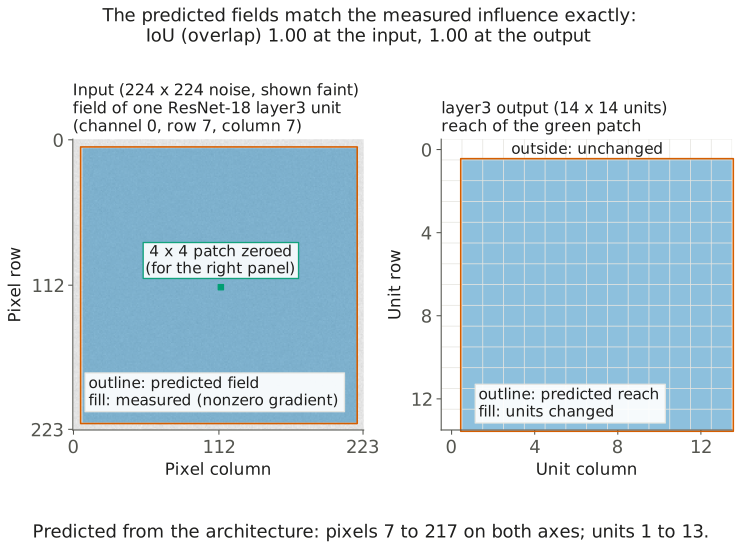
The figure is drawn from the saved cnn_fields.json and cnn_fields_figure.npz by the shared
gallery renderer; the script's --figure-only flag redraws it without rerunning the model.
| Item | Recorded setup |
|---|---|
| Claim | Geometric CNN influence supports input interventions and predicts projective support. |
| Script and run line | python examples/gallery/cnn_fields.py --out outputs/cnn_fields |
| Pinned inputs | torchvision ResNet-18, IMAGENET1K_V1, eval, float32, seed 17, one 224x224 random input; layer3, channel 0, centre unit. |
| Verdict | Passed; Linux x86_64 CPU, 3 November 2026, TorchLens 2.36.3, commit a676d9ab. |
| Cost | 11.6 s measured analysis; 23.6 s process wall time on two CPU threads, 778 MiB peak memory. |
Oracles
The rules are the ones registered for this entry before any run.
| Oracle | Rule | Measured | Outcome |
|---|---|---|---|
| Analytic box | Exact match of the clipped box with an independent analytic computation | Expected and measured [7,218) on both axes |
Pass |
| Gradient support | IoU >= 0.95 between the field and the input positions with nonzero gradient | 1.0 | Pass |
| Outside ablation | Nonempty outside mask; float32 unit delta exactly 0 | 5,655 spatial pixels zeroed; delta 0 | Pass |
| Inside ablation | Unit delta > 0 | 0.1923354864 | Pass |
| Projective support | IoU >= 0.95 against the units a plain run shows changed | 1.0 | Pass |
The first run of this script also required the field's relation label to be exact. TorchLens
labels this field upper_bound, which is its documented label for a strided hull: the hull can
contain positions that influence nothing, so it is reported as a superset (see
selection completeness, Lemma R). The coordinates are
exact; the label is reported here, not graded.
Controls
| Control | Rule | Measured | Outcome |
|---|---|---|---|
| Same-size outside patch | A 4x4 corner patch lies outside the field and changes the unit by exactly 0 | outside; delta 0 | Pass |
| Serial module chain | Treating the registered leaves as one chain (ignoring the branches) must give a different box | [207,224) against the branched [7,218) |
Pass (failed as declared) |
Artifact and replay
The full capture is saved as a portable cnn_fields.tlspec (34,539,731 bytes, sha256
6d860501249e5a54...). The script reloads it, zeroes the outside field of the reloaded input,
reruns the model and compares the unit with the reloaded value: the delta is exactly 0, as in
memory.
Basis-grid row
| Verbs | TorchLens lines | Plain-PyTorch lines | Architecture |
|---|---|---|---|
| capture, select, read, do, compare, save | 218 | 37 | ResNet-18 |
Counts are nonblank, noncomment, non-docstring lines. The TorchLens region includes setup, the command line, reporting, plotting and helpers; the plain region covers the independent geometry and the hook and gradient extraction. No count against an original reference implementation was measured.
The stamp
{
  "commit": "a676d9ab3e3b3393d68176622c1aa5fb3c730ec8",
  "date_utc": "2026-11-03T20:24:56Z",
  "device": "cpu",
  "libraries": {
    "numpy": "2.2.6",
    "torchvision": "0.28.0+cpu",
    "transformers": "5.18.0"
  },
  "machine": "x86_64",
  "platform": "Linux-7.0.0-1011-gcp-x86_64-with-glibc2.39",
  "python": "3.10.20",
  "torch": "2.13.0+cpu",
  "torch_threads": 2,
  "torchlens": "2.36.3",
  "wall_seconds": 11.6
}
Vary it
Use --layer layer2, --channel 1 or the explicit --arch resnet18 selector. --quick runs the
same headline input without extra architecture runs. VGG-16 and ConvNeXt are not claimed here.
These small examples use a randomly initialized torchvision residual block without downloads.
# recipe-test: tool=torchvision expected=True
import torch
from torch import nn
from torchvision.models.resnet import BasicBlock
import torchlens as tl

torch.manual_seed(17)
model = nn.Sequential(nn.Conv2d(3, 4, 3, padding=1), BasicBlock(4, 4)).eval()
x = torch.randn(1, 3, 16, 16)
trace = tl.trace(model, x, capture=tl.options.CaptureOptions(replayable=True))
box = trace["1"].receptive_field.at((8, 8))
RESULT = box.exact and all(a.clipped_stop - a.clipped_start == 7 for a in box.axes[-2:])