Smart-collapse visual reference
The images on this page are generated by
scripts/render_collapse_reference.py.
Run PYTHONPATH=$PWD python scripts/render_collapse_reference.py after rendering changes; it
updates this gallery and stages the same files in /tmp/collapse_renders/ for review.
The mode ladder
The same ResNet-18 execution is shown at each string mode. none preserves the full graph,
auto chooses the first schedule point in the readable band, and max applies the strongest
legal condensation.
auto then evens that point out, and only ever condenses further. A small module left expanded
beside boxed siblings is boxed too, when it hides no more ops than the smallest box beside it
(convnext's stem and stage-2 downsample), so stray raw ops do not sit between boxes. "Beside"
means a sibling box or a box one level inside a sibling; a box nested deeper (BERT's
encoder.layer.0 next to embeddings) leaves its neighbours expanded. A run of
three or more structurally identical, consecutive sibling boxes folds into one segment (convnext's
nine stage-2 blocks become stages.2.blocks.0-8 -- 9 blocks). The evened plan never shows more
nodes than the schedule point it started from; the ResNet-18, GPT-2 and BERT auto overviews are
unchanged.

collapse="none": every operation is visible, including the repeated residual stages that make
an overview hard to scan.
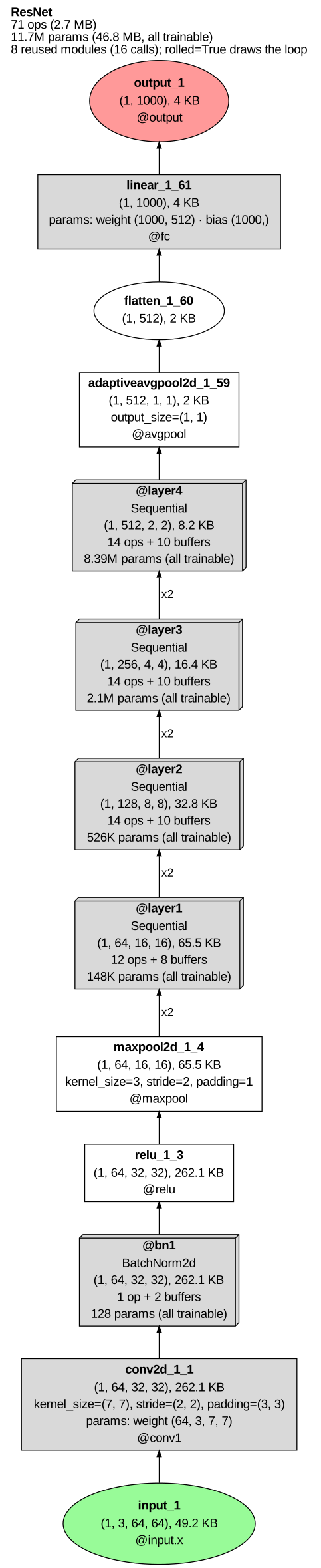
collapse="auto": representative module boxes preserve the stem-to-stage-to-head story while
their labels account for hidden work.
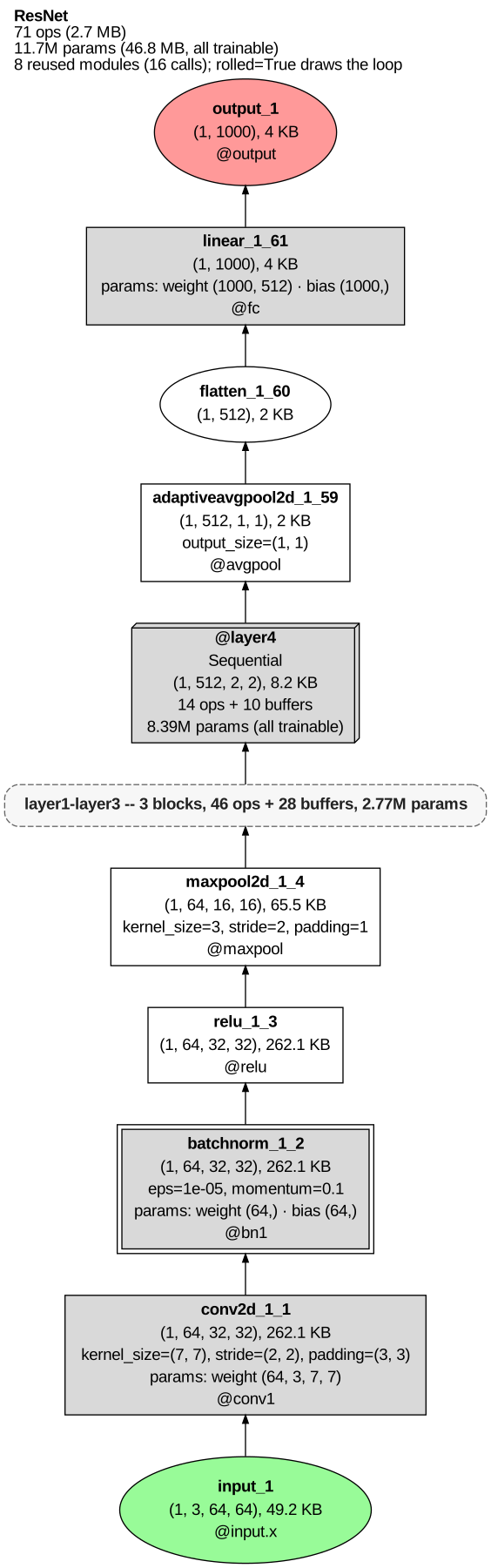
collapse="max": the same trace is condensed as far as the renderer can do honestly; it is not
a different execution.
The float-t schedule
A float t in [0.0, 1.0] selects the deterministic monotone collapse schedule. 0.0 equals
"none", 1.0 equals "max", and increasing t never expands a previously hidden address.

t=0.0: the full graph endpoint.

t=0.25: the first intermediate schedule point.

t=0.5: a further-condensed view of exactly the same execution.

t=0.75: hidden module addresses remain a superset of those at lower t.
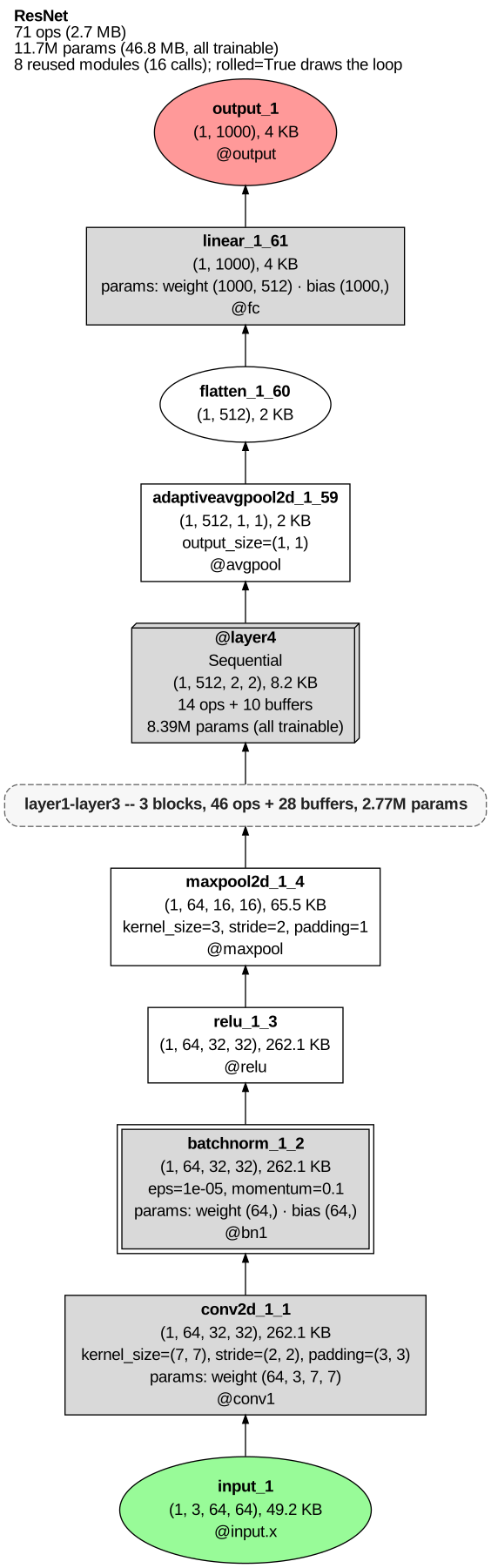
t=1.0: the maximum-collapse endpoint.
fold_repeats
Run folding is independent of module collapse. These two views use the same eight-block residual
stack with collapse="none"; the right-hand view folds only the repeated sibling run.

fold_repeats=False: all eight distinct residual-block instances are shown.
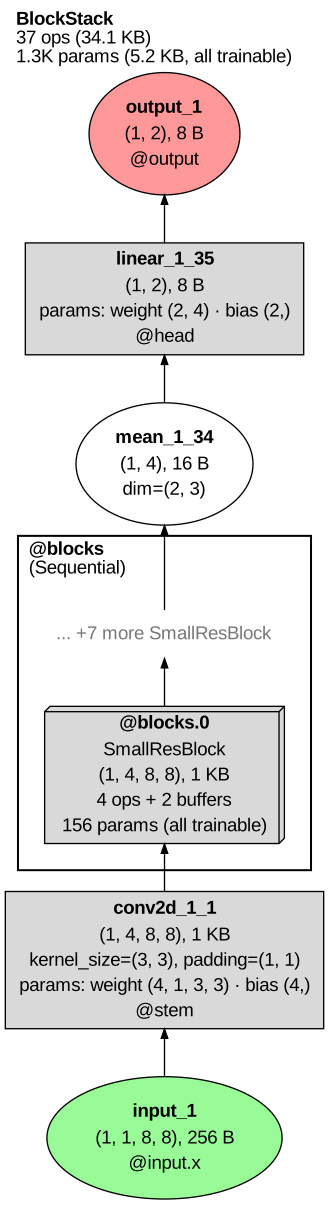
fold_repeats=True: one representative remains and the ellipsis accounts for the other
same-class siblings; the stem and head remain at full detail.
Segment boxes
collapse="max" can replace a legal consecutive sibling interval with a dashed segment box.
Legal means the members ran back to back in execution order and each feeds the next directly:
a box never groups same-kind siblings that alternate with other siblings, and never hides a
parent-owned op between its members, so the collapsed graph shows no edge or cycle the traced
network lacks.
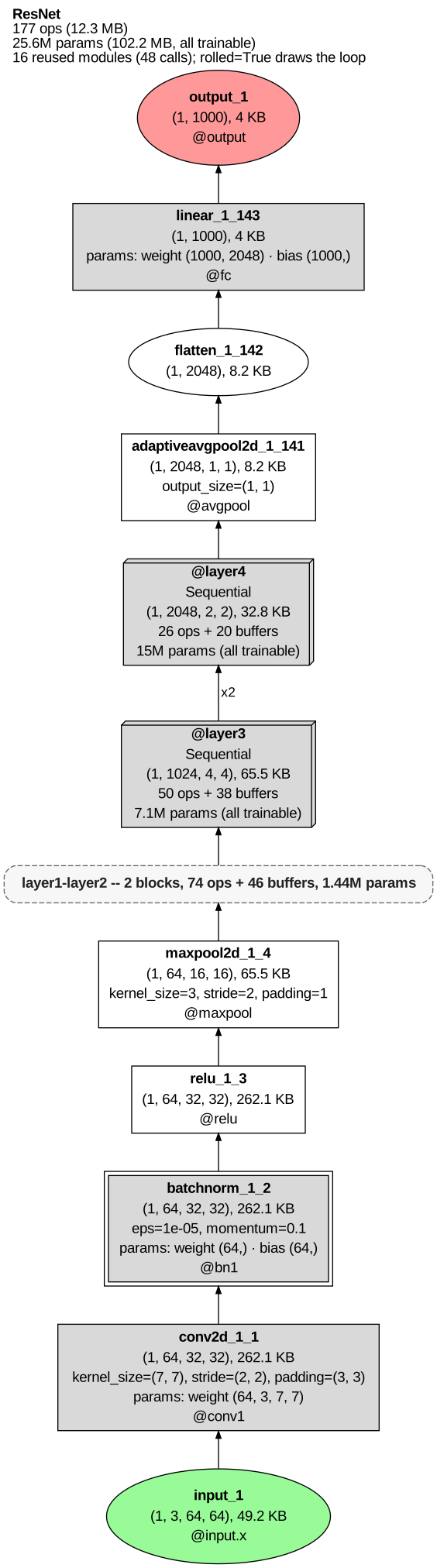
The dashed segment boxes in this ResNet-50 maximum-collapse view name an address range and totals. They assert adjacency only: a segment is not a real module and never pretends mixed content has one module class.
Output bundles
A decoder that returns its cache returns one output per cached tensor, and each would otherwise
draw as its own node. In an overview render (collapse="auto", "max" or a level above 0,
unrolled, without show_containers), three or more model outputs that share a container key and
named role, dtype and shape draw as one node, such as OUTPUTS: past_key_values.keys with
12 tensors, 1x2x8x8 each, when one top-level module made all of them and that module is drawn as
one box. When the module is expanded, its outputs come from several drawn nodes and every output
is drawn on its own again. A named single output such as logits or last_hidden_state is never
bundled, and collapse="none" never bundles. The bundle counts as one node in the readable band.
What (xN) and +N more promise
These labels look similar but make different, deliberately strict promises about hidden content.
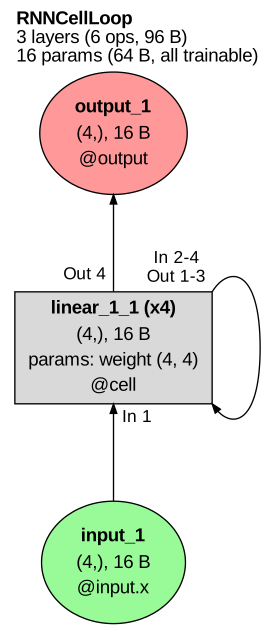
(xN) is a true recurrence multiplier: the same parameters were applied N times. This
rolled RNN-cell loop has weight reuse, not N independent blocks.
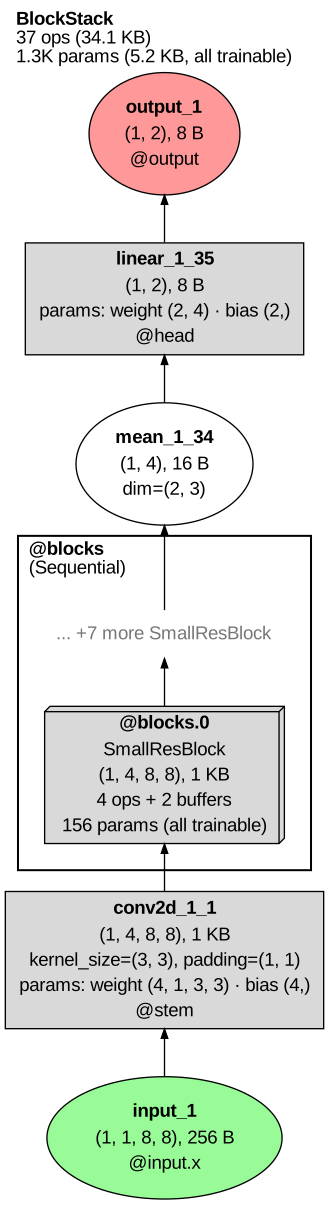
+N more Class means N additional distinct same-class instances, each with its own
parameters. The representative box describes one instance; the ellipsis makes the omitted sibling
count explicit. Collapsed-box remainders and segment totals likewise count everything they hide,
including buffer leaves. This is the honesty contract: labels never claim a repeated call, module,
or total that the hidden content does not support.
The compute ceiling
Smart-collapse admission is now gated on the RENDERED UNIVERSE, not raw op count
(collapse): the gate variable is U — the full plan's rendered node count after
module= focus, depth=, and rolled reductions — tiered by a measured
(U, W) work estimator (0.0095 * U**1.43 * W**1.02 ms, W = widest rendered sibling
group). COLLAPSE_OPTIMIZER_MAX_OPS (2000) survives as the defensive constant: the
quality planner is admitted when U <= 2000 AND the predicted cost fits the budget.
- Over-budget requests degrade to a deterministic compact fallback plan
(significance-greedy boxes plus standard fold discovery), disclosed with the coded
collapse_budget_fallbackwarning andOptimizerResult.planner="linear_fallback"— never an uncollapsed wall. - Only PATHOLOGICAL inputs (raw ops above 20x the constant) still decline outright:
drawwarns (collapse_pathological_skip) and renders a bounded top-level module overview plus an expansion manifest (uncollapsed only when the root has no child module), a forward drawing'sDrawing.collapse_planrefuses typed (collapse_plan_unavailable, reasoncollapse_ops_ceiling), and itsDrawing.collapse_scheduledegrades to a single full-graph step. - Over-ceiling residuals (experimental): when the served
overview is still above the readable band -- a floor-fallback plan, or the
pathological top-level overview --
drawwrites<outpath>.expansion.jsonbeside the picture (schematorchlens_expansion_manifest_v1: one entry per collapsed unit with a stableexpansion_idand thedraw()keywords that open it) and warnscollapse_expansion_manifestwith its path. - A generous wall-clock watchdog (off in CI and under
TORCHLENS_DETERMINISTIC;TORCHLENS_COLLAPSE_WATCHDOG=0disables) may abandon the quality planner mid-run to the same fallback; every firing is disclosed as an estimator bug (collapse_watchdog_fallback, with U, W, predicted, and actual).
Context reductions are therefore real remedies for the first time: focusing with
module=, bounding depth=, or rendering rolled genuinely re-admits the
quality planner. The gate is a compute guard, not a correctness limit — the trace
itself is complete.
The decline is disclosed, never silent. To get a collapsed view of a very large trace, reduce
the rendered graph first with module= focus, depth=, or rolled mode; fold_repeats
and show_containers styling are unaffected.
Drawing.collapse_plan diagnostics
The Drawing a forward trace.draw(...) returns carries the diagnostics for the picture it
rendered. Drawing.collapse_plan is the renderer-faithful plan the drawing was built from: its
mode is the draw call's collapse= ("auto", "max", or a float level) and its context is the
render request the draw resolved, so rolled or unrolled, module= focus, depth=, and theme all
follow the draw call. Drawing.collapse_schedule exposes the ordered float steps, targets, visible
counts, and collapsed module addresses under that same context. Use these diagnostics to inspect a
rendering decision rather than inferring it from pixels.
import torch
from torch import nn

import torchlens as tl

model = nn.Sequential(nn.Linear(4, 4), nn.ReLU()).eval()
trace = tl.trace(model, torch.randn(2, 4))
drawing = trace.draw(collapse="auto", file_format="dot")
plan = drawing.collapse_plan
schedule = drawing.collapse_schedule
level_plan = trace.draw(collapse=0.5, file_format="dot").collapse_plan
Both properties refuse typed (collapse_plan_unavailable) for a backward or combined graph, an
animation, or once the source trace has been released; collapse_plan also refuses for a drawing
made with collapse="none", which has no plan. To compare modes, make one draw call per mode.
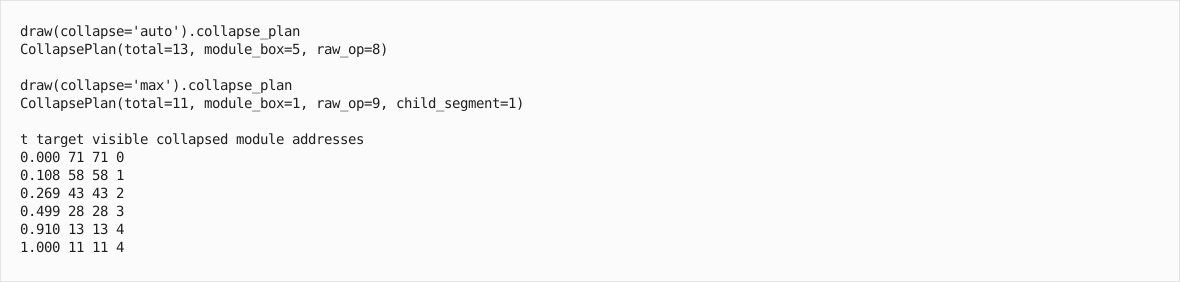
This image is generated from the same ResNet-18 trace as the ladder. It shows real auto and
max plans followed by every schedule step; visible counts are monotone as t increases.