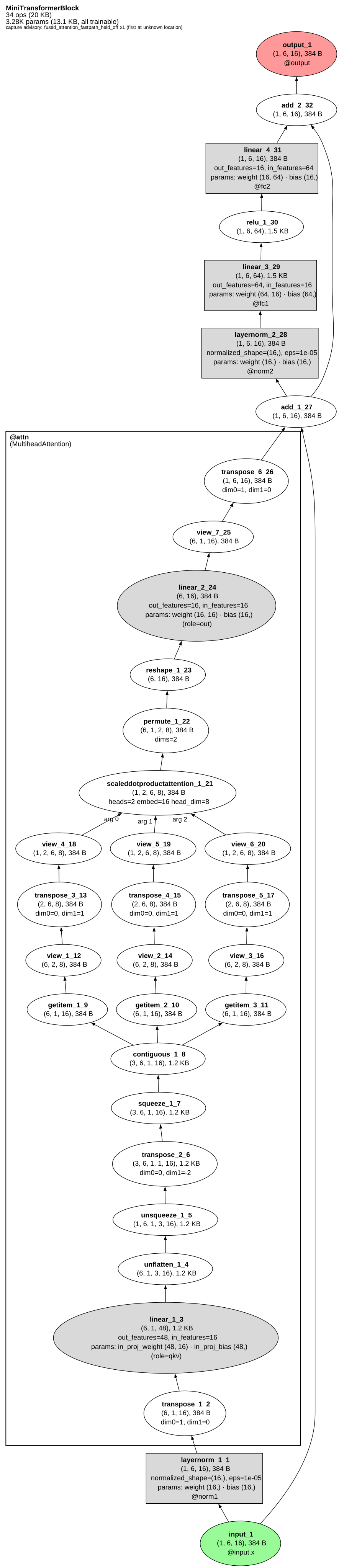
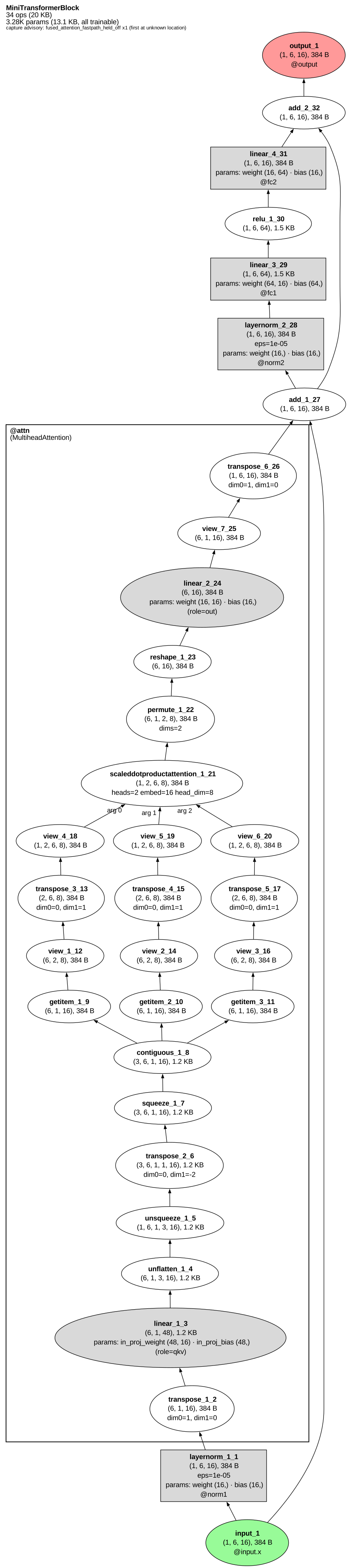
Node labels and encoding channels
Every name on this page is experimental (keyword-only) and may change in any release.
All images under docs/images/encoding/ are regenerated by
python scripts/render_encoding_reference.py.
Encoding channels
One declarative surface: a VALUE SOURCE (record field name, builtin token,
or callable node -> value) mapped to a VISUAL CHANNEL, each with a
normalization, a scale transform and a plain drawn key, with the details kept on the encoding
state (see "The key" below). Channels are strictly
presentation-only (the Trace and collapse plan are untouched), strictly
opt-in (plain draw() is byte-identical), and dot-layout-only
(layout="auto" forces dot when a channel is active; explicit
layout="rank" refuses encoding_requires_dot_layout).
color_by — sequential fill
draw(color_by="time") fills eligible op nodes from a colorblind-safe,
perceptually uniform sequential ramp, normalized linear min-max over visible
nodes; the key draws a colour bar labelled with the quantity and its units at
both ends. Missing or rolled-ambiguous values leave nodes unencoded with a
note on the encoding state.
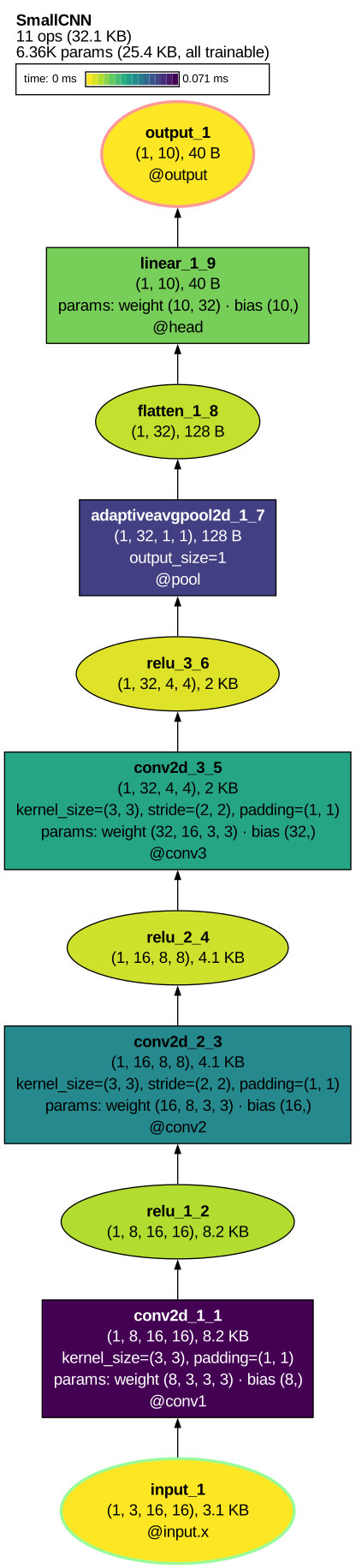
color_by="device_time" / size_by="device_time" (torchnative.3) read
the session-time Kineto join: exact-attribution device nanoseconds per
pass-qualified op, summed, with the mandatory aggregation line in the
encoding state, on rolled nodes. The channel exists only on a trace captured under an owned
profiler session whose join reached joined
(torchlens.report.kernel_profile); explicitly requesting it
anywhere else refuses typed (device_time_unavailable) with the cause and
remedy — never silent zeros. Joined-but-kernel-less nodes read honest n/a.
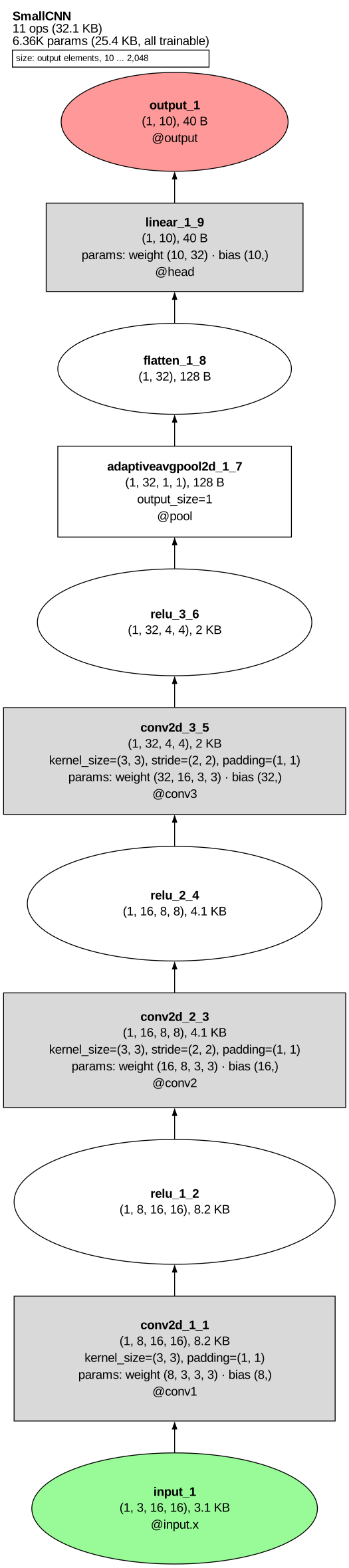
size_by + scale — node area
size_by accepts the same builtin tokens as color_by with the same
meaning and units ("time", "bytes", "flops", "magnitude",
"grad_norm", "device_time"), plus record field names, callables, and
the shape token "dims": draw(size_by="dims", size_scale="sqrt") sizes nodes
by the numel of the non-batch output shape (the conservative area-only
mapping). On rolled multi-pass nodes a source that cannot be certified
single-valued refuses (size_by_rolled_varying).
Sizes are label-aware. Once every label is resolved, the draw estimates each
label box and takes the median box among the size-encoded nodes as the base:
the smallest-value node is the size of a typical label, and area grows
linearly to 4x the base at the largest value. Nodes with typical labels share
the base, so their areas compare directly. A node whose label is wider or
taller than the median starts from its own label box instead and grows by the
same factor, so one long argument row never inflates every node.
Sizes are emitted as width/height MINIMUMS under fixedsize=false: labels
never truncate and fonts never scale. A node_spec_fn that sets its own
width/height keeps them.
Collapsed module boxes and segments
When the graph is collapsed (depth=N, collapse="auto", collapse="max"),
module boxes and segment capsules are encoded too. A box's value is the
EXACT sum of its member ops for additive sources: "time"
(func_duration), "bytes" (activation_memory), "flops"
(flops_forward), "device_time", and the additive fields
transformed_activation_memory, flops_backward, flops_total and
macs_forward. The encoding state records the aggregation (module boxes: sum over
member ops, ... across all calls on rolled views, segments: sum over
member ops). An op with no function (inputs, outputs, buffers) contributes
zero time and flops. A box with any member op missing a value is left
unencoded with a note on the encoding state rather than shown with a partial sum. Sources
with no exact sum over ops ("magnitude", "grad_norm", "dims", other
fields, callables) leave every box unencoded, and the encoding state says so
(collapsed nodes unencoded: <source> has no exact sum over ops). A repeat
fold box shows its representative module only, and the encoding state notes it.
The key
The drawn key carries no explanation lines. With color_by it is a small
colour bar labelled with the quantity and its units at both ends
(time: 0.098 ms [bar] 1.46 ms); with size_by, one line
(size: output bytes, 15 KB ... 60 KB); with stack_by, one line
(aligned: same <annotation>). When no value range exists the colour key is
one line instead (time: all 0.1 ms, time: no values).
The drawing carries nothing else: no transform, coverage or scale wording,
drawn or in the DOT source. show_legend=False drops the key.
The ramp is a stop list blended in OKLab, with each stop placed at its share
of the path's perceptual length, so equal value steps read as equal colour
steps. The default is viridis: on a light page low is yellow and high is
dark purple, on the dark page the list runs the other way (high is bright).
ColorBrewer YlOrBr (light page: its 9-class list without the near-white first
class) is built in as a named alternative, selected by one internal constant
(torchlens/_visualization/_ramps.py).
stack_by — rank columns (the classic timestep diagram)
draw(stack_by=True, direction="leftright") pins nodes sharing an
annotation value to one Graphviz rank. The auto form derives pass_number
on multi-pass ops under the LOCKSTEP LICENSE (globally monotone execution
windows); the caption discloses the annotation used, and the key line reads
aligned: same <annotation>.
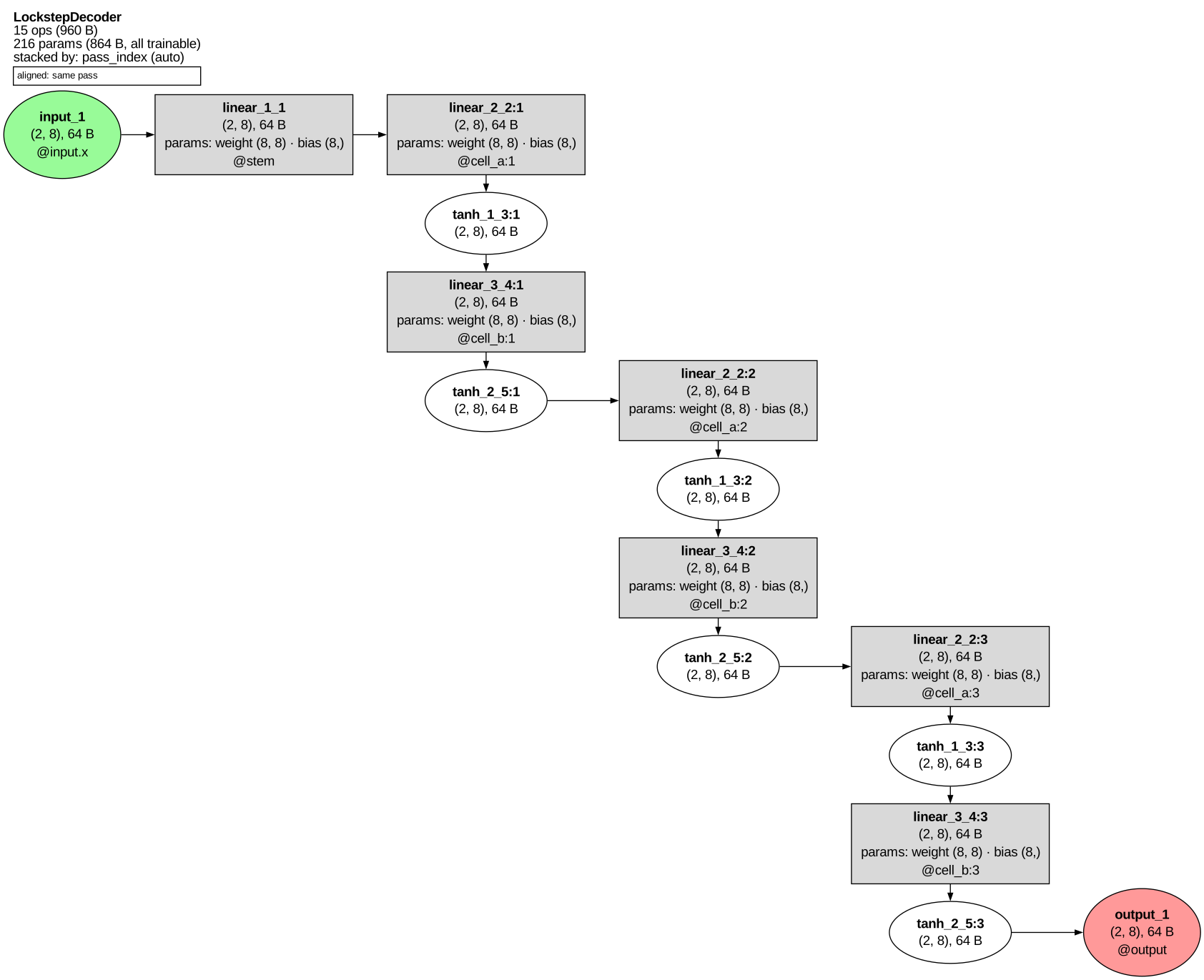
A non-lockstep trace (e.g. two sequential loops) REFUSES the auto form
(stack_by_auto_underivable) — no ground truth for "same column = same
timepoint" exists. An explicit annotation bypasses the license (the user
asserts their own semantics, disclosed in the caption):

Across-pass shape summary row
A rolled multi-pass layer whose passes vary in output shape carries
Layer.shape_summary (L1's derived field: "4->2" monotone, "4-2"
min-max, full first->last shapes for multi-axis variation). When set, the
default node label renders it VERBATIM as one plain-text row directly after
the title row, escaped by the standard choke point. Single-pass layers and
unrolled per-pass nodes carry no summary row. The node_label_fields
selector token "shape_summary" adds the row to explicit field pickers
(skipped when the field is unset).
The "dtype" selector token adds the node's output
dtype as one row, framework namespace dropped ("float16"), for reading where
a mixed-precision graph changes dtype:
trace.draw(node_label_fields=["name", "shape", "dtype"]). Nodes without a
dtype contribute no row.
Saved-for-backward annotation (opt-in)
draw(show_saved_for_backward=True) makes autograd's
memory behaviour visible per node: every op whose grad_fn measurably retained tensors
for the backward pass gains one plain-text label row,
saved for backward: N tensors, X MB, from the capture-time num_autograd_tensors /
autograd_memory measurements (deduped by storage within each op). The row appears
ONLY where retention was measured as positive — an op that saved nothing, or whose
backward graph was never built (e.g. a torch.no_grad() capture), gets no row, so an
absent row makes no claim. On rolled multi-pass layers the stored measurements are
already cross-pass sums and the row discloses (total across passes). Strictly opt-in:
plain draw() labels are unchanged. Explicit node_label_fields pickers keep full
control of their rows (no annotation is injected). Composes with
color_by="autograd_memory" to add a ramp over the same quantity.
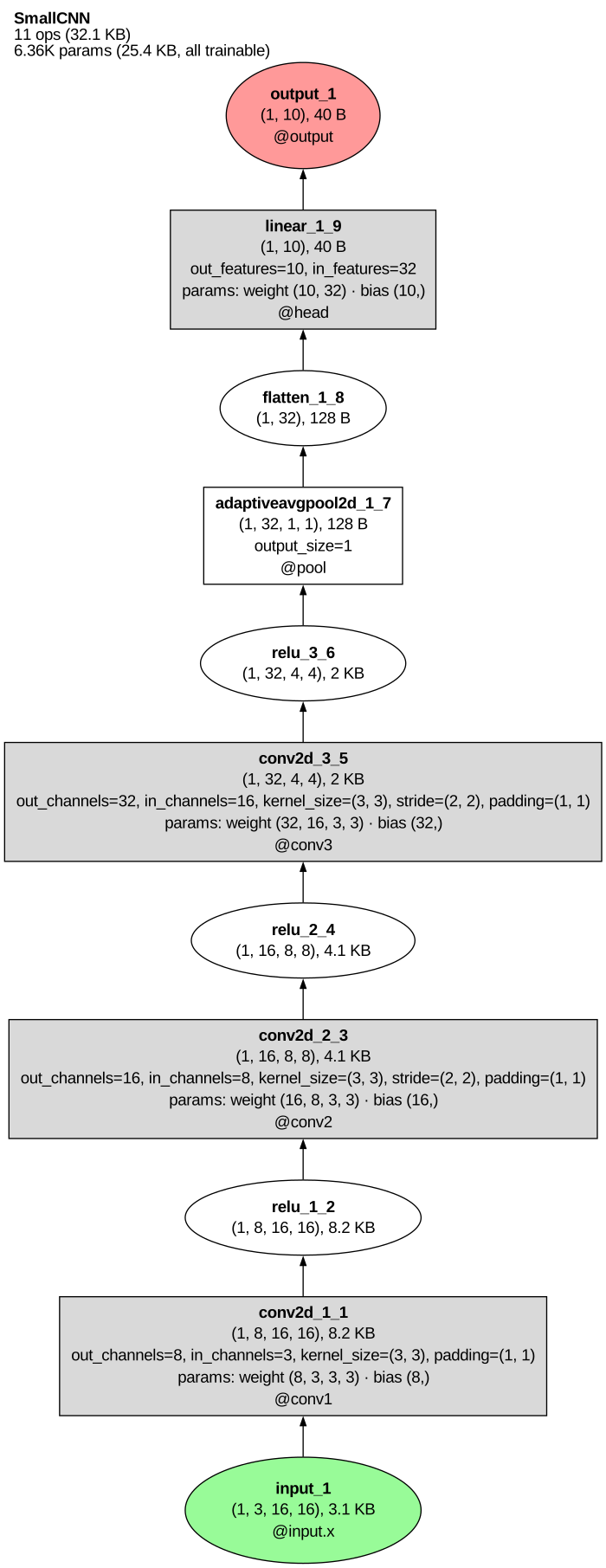
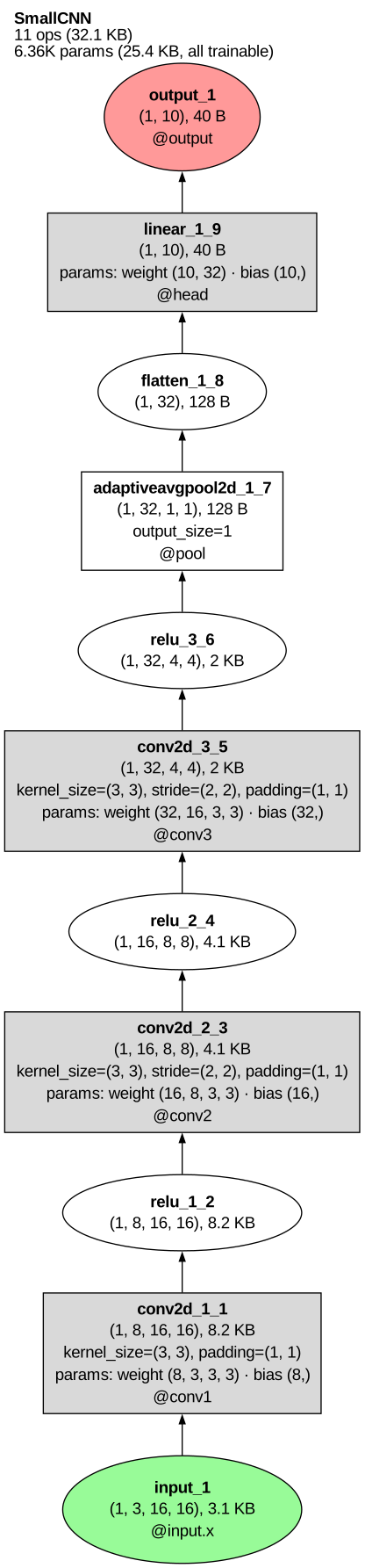
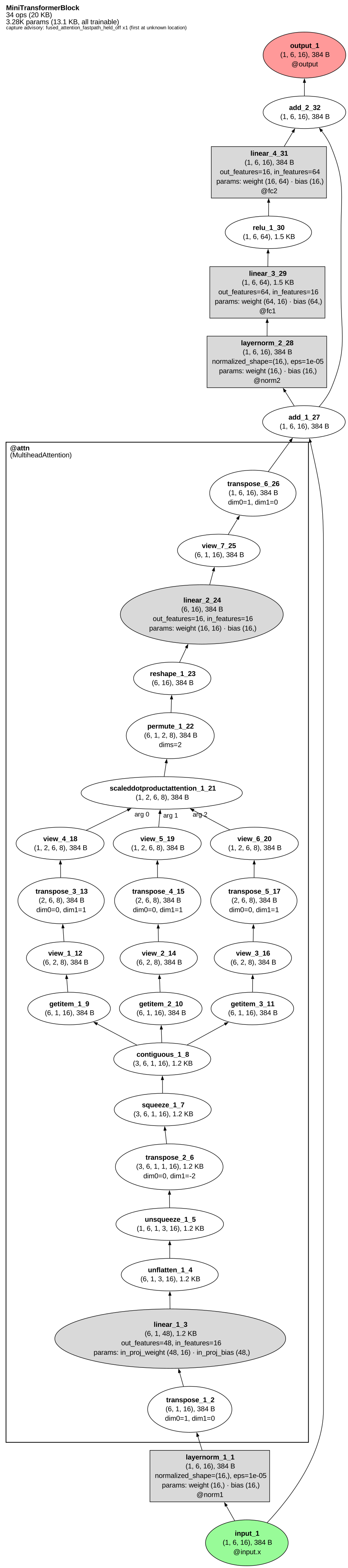
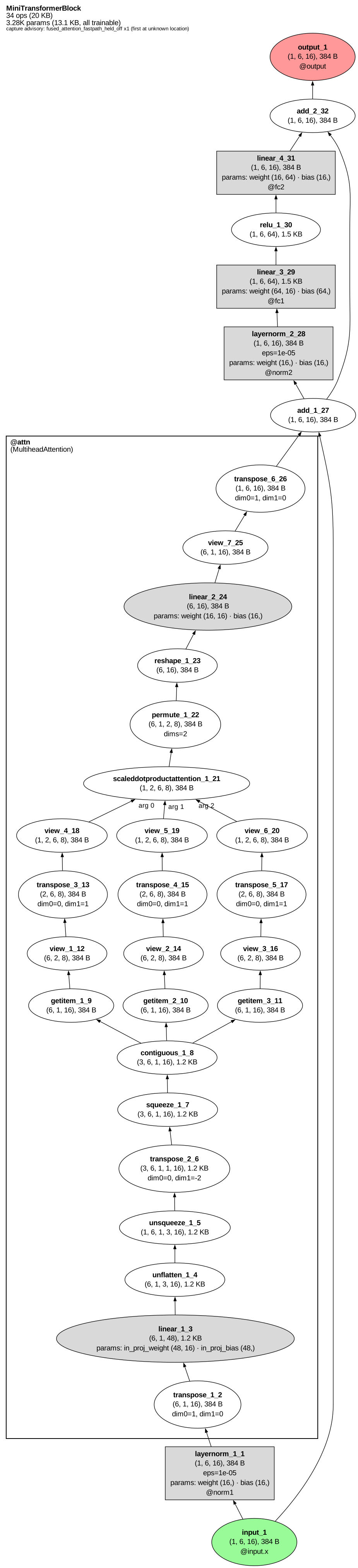
Checked suppression of redundant constructor args (default-on)
Node labels omit a module constructor arg exactly when the check licenses
it: the arg value provably equals the captured shape dimension it claims
to duplicate on this trace. in_features=32, out_features=10 on a Linear
whose input/output rows already show (1, 32) -> (1, 10) says nothing the
label does not already say — so it is suppressed. A mismatch or an
unavailable shape keeps the arg visible: the mismatch case is exactly the
interesting one, so the rule can only reveal more, never hide a
discrepancy.
- Eligibility is a closed table of torch nn module families (linear
in/out_features, conv in/out_channels, batch/instance-norm num_features,
layernorm normalized_shape, embedding embedding_dim, MHA embed_dim).
Axis semantics are the PyTorch module contract (channel = logical axis 1;
channels_lastis a memory format, not a logical shape change). - Never candidates (not recoverable from I/O shapes): kernel_size, stride, padding, dilation, groups, num_embeddings, num_heads, dropout p.
- Input-side rows check the single incoming data edge's source shape; multi-input or shape-less parents stay visible. Non-torch backends and unrecognized modules are never candidates. Ambiguity never suppresses.
- A rolled multi-pass aggregate whose passes disagree on shape has no single output shape, so its args stay visible while the unrolled per-pass nodes suppress — a deliberate, honest cross-mode difference.
- Detached/standalone records render all args (no trace to check against).
draw(show_redundant_args=True) shows every captured arg.
Before/after (conv):
Before/after (transformer block):
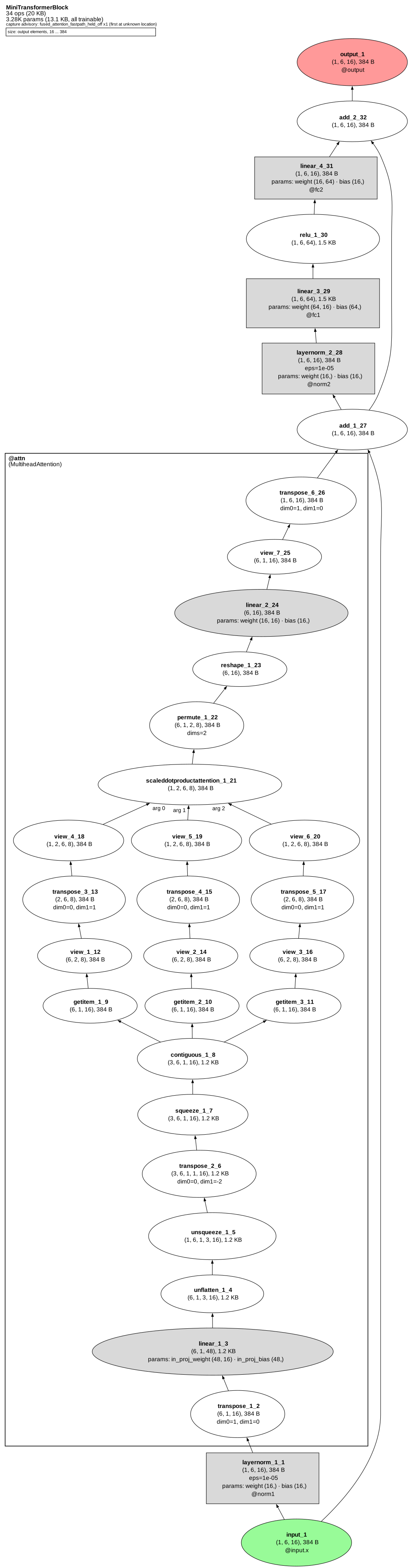
Before/after (attention style, node_spec_fn=torchlens.experimental.node_styles.attention_node_mode):