A protein language model: ESM-2 traced
TorchLens on a biology model: ESM-2, a protein language model trained to fill in masked amino acids, traced on one protein. The smallest ESM-2 (6 layers, 8 million parameters) runs on a CPU in a few seconds. The page shows what one trace captures, reads a per-residue score straight from a captured site, and turns the captured attention maps into a predicted residue contact map.
Requirements: pip install torchlens transformers matplotlib. The first run downloads the
31 MB checkpoint facebook/esm2_t6_8M_UR50D (MIT license) from the Hugging Face Hub, pinned to
one revision; no GPU.
1. Load and trace
The protein is human ubiquitin, 76 residues. The tokenizer adds a start and an end token, so
the model sees 78 positions. Eager attention makes each layer's attention probabilities an
ordinary softmax call TorchLens can capture.
# recipe-test: tool=esm expected=('COMPLETE', (1, 78, 33))
import torch
from transformers import AutoTokenizer, EsmForMaskedLM

import torchlens as tl

MODEL_ID = "facebook/esm2_t6_8M_UR50D"
REVISION = "c731040fcd8d73dceaa04b0a8e6329b345b0f5df"
UBIQUITIN = "MQIFVKTLTGKTITLEVEPSDTIENVKAKIQDKEGIPPDQQRLIFAGKQLEDGRTLSDYNIQKESTLHLVLRLRGG"

tokenizer = AutoTokenizer.from_pretrained(MODEL_ID, revision=REVISION)
model = EsmForMaskedLM.from_pretrained(
    MODEL_ID, revision=REVISION, attn_implementation="eager", dtype=torch.float32
).eval()
tokens = tokenizer(UBIQUITIN, return_tensors="pt")

trace = tl.trace(model, (), input_kwargs=dict(tokens))
logits = trace["output_1"].out
print(f"{len(trace.layers)} layers, {sum(1 for m in trace.modules if m.num_calls)} modules called")
RESULT = (trace.outcome.status.name, tuple(logits.shape))
The trace holds every operation of the forward pass (391 of them) with its output, inside the module that ran it. The output site holds the logits: one score for each of the 33 tokens in the vocabulary at each of the 78 positions.
2. The attention maps are captured sites
Each of the six layers computes attention probabilities for 20 heads with one softmax.
Selecting by function finds all six; selecting by function inside a module finds one layer's.
The captured maps are the same tensors the model returns when asked for its attentions.
# recipe-test: tool=esm expected=(6, (1, 20, 78, 78), True)
attention = trace.find_sites(tl.func("softmax"))
last = trace.find_sites(tl.in_module("esm.encoder.layer.5.attention") & tl.func("softmax"))

with torch.no_grad():
    returned = model(**tokens, output_attentions=True).attentions
maps = [site.out for site in attention]
same = all(torch.allclose(m, r) for m, r in zip(maps, returned))
RESULT = (len(maps), tuple(last.first().out.shape), same)
3. A per-residue readout
The model's log-probability of the native amino acid at each position is a per-residue score of how expected that residue is in its context. It comes from the captured output site with no second forward pass. Without masking, the most likely amino acid is the native one at 72 of the 76 positions.
# recipe-test: tool=esm expected=(76, 72)
residue_logits = logits[0, 1:-1]  # drop the start and end tokens
native = tokens["input_ids"][0, 1:-1]
native_logp = residue_logits.log_softmax(dim=-1).gather(1, native[:, None])[:, 0]
recovered = residue_logits.argmax(dim=-1) == native
print(f"mean native log-probability {native_logp.mean():.3f}")
RESULT = (len(native_logp), int(recovered.sum()))
4. Contacts from the captured attention
ESM-2 carries a small logistic-regression head that predicts which residue pairs touch in the
folded protein from the attention maps of every layer and head (Rao et al., 2021). Feeding it
the captured maps gives the same contact map as the model's own predict_contacts.
# recipe-test: tool=esm expected=((76, 76), True)
with torch.no_grad():
    contacts = model.esm.contact_head(tokens["input_ids"], torch.stack(maps, dim=1))[0]
    reference = model.esm.predict_contacts(tokens["input_ids"], tokens["attention_mask"])[0]
RESULT = (tuple(contacts.shape), torch.allclose(contacts, reference, atol=1e-6))
5. Picture
The top panel is the per-residue score, with the four positions where the model prefers a different amino acid marked in red. The bottom panel is the contact map from the captured attention. Pairs fewer than six residues apart are masked, as is usual for contact maps, since neighbours in the chain are always close.
# recipe-test: tool=esm expected=True
from pathlib import Path

import matplotlib.pyplot as plt

n = len(UBIQUITIN)
fig, (top, bottom) = plt.subplots(
    2, 1, figsize=(7, 8.9), gridspec_kw={"height_ratios": [1, 3.4]}, layout="constrained"
)
fig.suptitle("ESM-2 (8M) on human ubiquitin: both panels read from one TorchLens trace",
             fontsize=12)
colors = ["#B0B0B0" if hit else "#c0392b" for hit in recovered.tolist()]
top.bar(range(1, n + 1), native_logp.detach().numpy(), color=colors, width=0.85)
top.set_xlim(0.5, n + 0.5)
top.set_xlabel("residue")
top.set_ylabel("log p(native)")
top.text(0.01, 0.06, "red: another amino acid ranked first", transform=top.transAxes,
         ha="left", color="#c0392b", fontsize=9)
top.set_title("Log-probability of the native amino acid (output logits)", loc="left",
              fontsize=11)
for side in ("top", "right"):
    top.spines[side].set_visible(False)

index = torch.arange(n)
shown = contacts.clone()
shown[(index[:, None] - index[None, :]).abs() < 6] = float("nan")
greys = plt.get_cmap("Greys").copy()
greys.set_bad("#EFE3C8")
image = bottom.imshow(shown.numpy(), cmap=greys, vmin=0, vmax=1,
                      extent=(0.5, n + 0.5, n + 0.5, 0.5))
for text, cell, where in (
    (r"$\beta$1-$\beta$2 hairpin", (13, 4), (30, 9)),
    ("I44-V70", (70, 44), (56, 30)),
):
    bottom.annotate(text, xy=cell, xytext=where, fontsize=9, color="#333333",
                    arrowprops={"arrowstyle": "-", "color": "#333333", "lw": 0.8})
bottom.set_xlabel("residue")
bottom.set_ylabel("residue")
bottom.set_title("Contacts from the six attention maps (beige: under 6 residues apart, masked)",
                 loc="left", fontsize=11)
fig.colorbar(image, ax=bottom, shrink=0.8, label="contact probability")
fig.savefig("esm2_ubiquitin.png", dpi=150, facecolor="white")
plt.close(fig)
RESULT = Path("esm2_ubiquitin.png").stat().st_size > 0
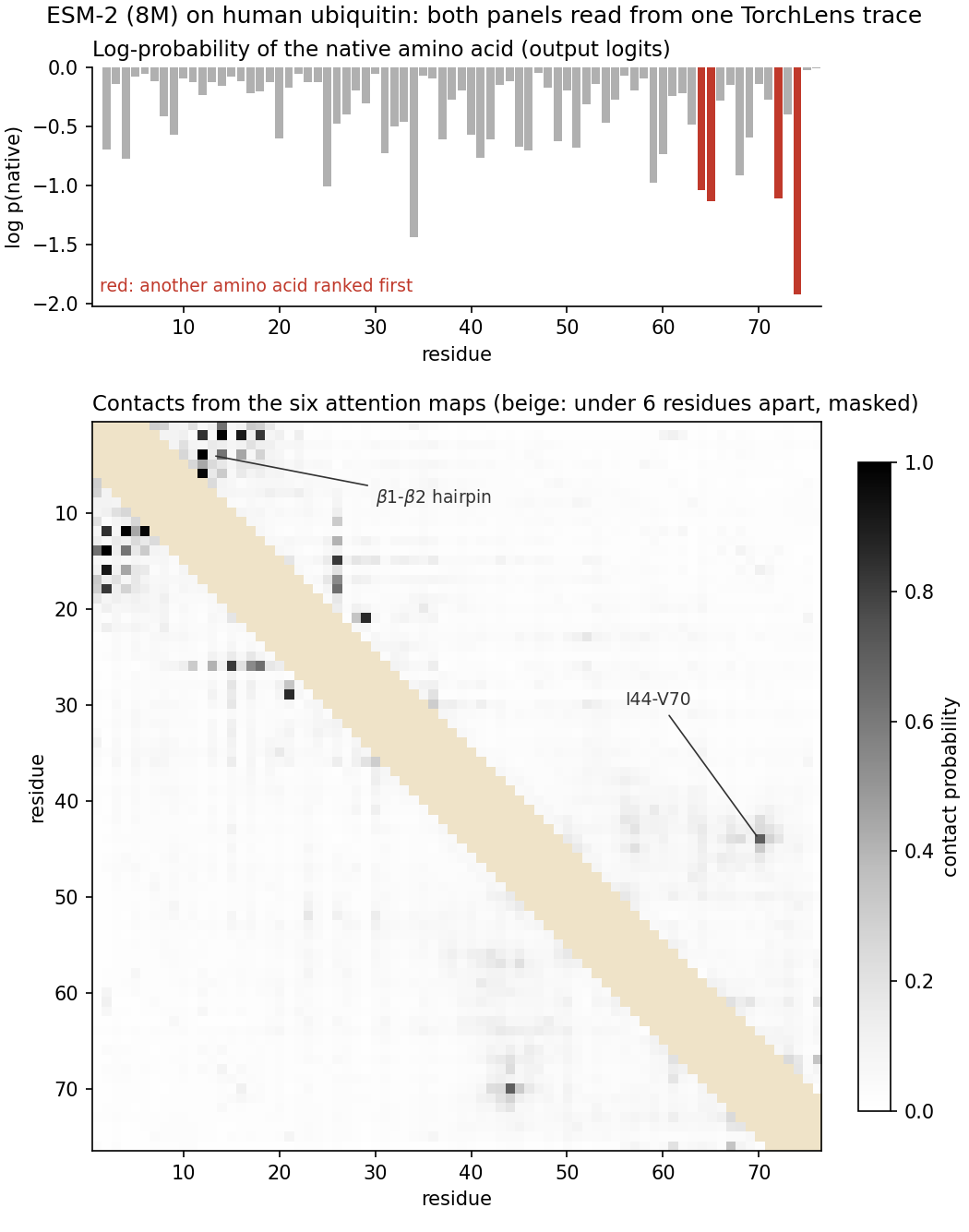
The strongest contacts pair residues 2 to 6 with 12 to 16, the hairpin formed by ubiquitin's first two beta strands, and isoleucine 44 with valine 70, two residues of the hydrophobic patch on ubiquitin's surface that binding partners recognise. The model learned these from sequences alone; it never saw a structure.
6. Edit and read again
Interventions work on this trace as on any other model. Zeroing the last layer's attention probabilities and replaying the forward pass from there lowers the number of positions where the native amino acid ranks first from 72 to 67.
# recipe-test: tool=esm expected=67
edited = trace.fork().do(last, tl.zero_ablate())
edited_logits = edited["output_1"].out[0, 1:-1]
RESULT = int((edited_logits.argmax(dim=-1) == native).sum())
Where to go next
- The NeuroAI journey and task RNN circuits use the same capture and edit calls on vision models and trained recurrent networks.
- The larger ESM-2 checkpoints (35M to 15B parameters) have the same module names, so the selectors on this page carry over unchanged.