Neuro extraction with an order-error control
Representational similarity analysis compares stimuli by the dissimilarity of a layer's activations (an RDM). This entry extracts per-layer RDMs with TorchLens on ResNet-18 and ViT-B/16 and checks them against independent plain-hook extraction and against rsatoolbox 0.3.2. A control shuffles the stimulus order on one side: the RDMs must stop agreeing and the stamp must flag the mismatch, so an order bug cannot pass silently. The entry passes on both architectures. The layer-ranking target is synthetic, and no neuroscience benchmark result is claimed.
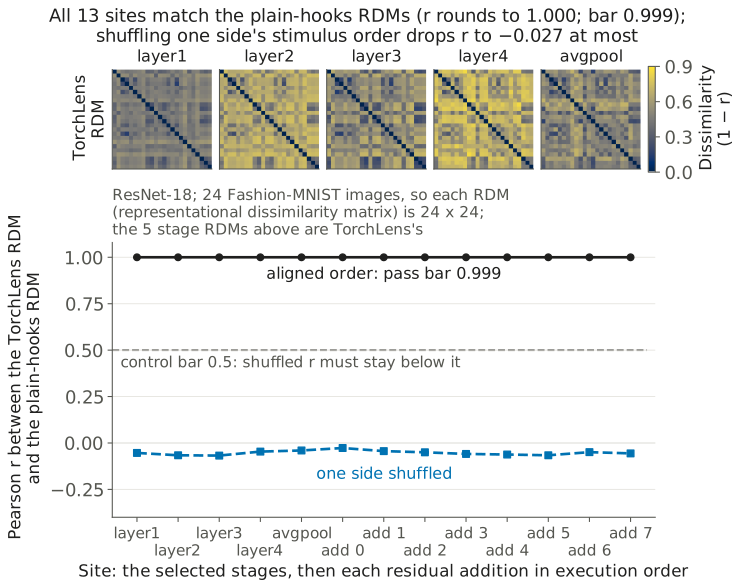
The figure is drawn from the ResNet-18 run's saved neuro_rdms.json and neuro_rdms_figure.npz by
the shared gallery renderer; the script's --figure-only flag redraws it without rerunning the model.
| Item | Recorded setup |
|---|---|
| Claim | Layer-wise and residual-add RDMs agree with independent extraction and rsatoolbox. |
| Script and run line | python examples/gallery/neuro_rdms.py --out outputs/neuro_rdms/resnet18 (add --arch vit_b_16 for ViT-B/16) |
| Pinned inputs | ResNet-18 and ViT-B/16, IMAGENET1K_V1, eval, float32; first 24 Fashion-MNIST test images in split order; RGB, antialiased bilinear 224x224, ImageNet normalization; seed 17. |
| Data hash | Compressed-file SHA256 346e55b948d973a97e58d2351dde16a484bd415d4595297633bb08f03db6a073. |
| Verdict | Passed on both; Linux x86_64 CPU, 3 November 2026, TorchLens 2.36.3, commit a676d9ab. |
| Cost | ResNet-18: 19.0 s analysis, 35.1 s process wall, 1.09 GiB peak memory. ViT-B/16: 66.8 s analysis, 83.9 s process wall, 2.66 GiB peak memory. Two CPU threads each. |
The Fashion-MNIST source supplies images
under its MIT license. The hash is independently listed by
TensorFlow Datasets.
The script verifies the hash before decompression and preserves identifiers
fashion-mnist:test:00000 onward. It does not redistribute the dataset.
Oracles
The rules are the ones registered for this entry before any run.
| Rule | ResNet-18 | ViT-B/16 |
|---|---|---|
| Every per-layer RDM from TorchLens has Pearson >= 0.999 with the RDM from independent plain-hook extraction | minimum 0.9999999999999988, pass |
minimum 0.9999999999988609, pass |
Every RDM from tl.neuro.rdms matches rsatoolbox's own calc_rdm pipeline on the same TorchLens activations to max abs 1e-6 |
maximum 8.88e-16, pass |
maximum 8.33e-15, pass |
| Same best layer on the synthetic final-stage target | avgpool for both, pass |
encoder.ln for both, pass |
ResNet includes five stages and all eight pre-ReLU residual additions. ViT includes three stages, the positional sum and all 24 encoder residual additions; its fifth encoder layer's output is also one of the residual sums, so 28 requested sites resolve to 27 unique ones. The independent path uses plain forward hooks and recomputes each residual sum itself.
The first run of this script compared TorchLens RDMs with rsatoolbox RDMs built from the
plain-hook activations instead, at the same 1e-6 bar. On ResNet-18 that difference is
4.97e-13. On ViT-B/16 it is 1.065e-6, at the fifth encoder layer. The reason is that TorchLens
switches off PyTorch's fused attention fast path while it captures, so that every operation
inside attention is visible, and the fused kernel rounds differently. With the fast path also
switched off for the plain hooks (torch.backends.mha.set_fastpath_enabled(False)), a separate
check on random input found the plain-hook and TorchLens activations bitwise equal at all twelve
encoder layers and the final norm.
Controls
Shuffle one side with NumPy seed 123: every correlation must fall below 0.5. ResNet-18's range
was [-0.0679, -0.0272] and ViT-B/16's [-0.0851, 0.0005]: both pass. Comparing the stored
stimulus identifiers flags the mismatch on both, and both stamps record
stimulus_order_mismatch=true.
Artifact and replay
Each run saves a portable neuro_rdms.tlspec holding the activations, addresses, stimulus IDs,
preprocessing, shuffled IDs and RDMs. After tl.load, the script recomputes the first RDM from
the reloaded activations: both replay errors are exactly 0, and the stored order mismatch stays
flagged.
| Run | Bytes | sha256 |
|---|---|---|
| ResNet-18 | 109,342,735 | 123ddac580a56a5c... |
| ViT-B/16 | 394,121,467 | ad2b998b8d4804db... |
Basis-grid row
| Verbs | TorchLens lines | Plain lines | Architectures |
|---|---|---|---|
| capture, select, read, compare, save | 226 | 56 | ResNet-18, ViT-B/16 |
Counts are nonblank, noncomment, non-docstring lines. The TorchLens region includes setup, the command line, plotting, reporting and helpers; the plain region covers independent extraction, residual recomputation and rsatoolbox. Lines of the original thingsvision reference were not measured.
The stamp
ResNet-18:
{
  "commit": "a676d9ab3e3b3393d68176622c1aa5fb3c730ec8",
  "date_utc": "2026-11-03T20:25:11Z",
  "device": "cpu",
  "libraries": {
    "numpy": "2.2.6",
    "rsatoolbox": "0.3.2",
    "torchvision": "0.28.0+cpu",
    "transformers": "5.18.0"
  },
  "machine": "x86_64",
  "platform": "Linux-7.0.0-1011-gcp-x86_64-with-glibc2.39",
  "python": "3.10.20",
  "stimulus_order_mismatch": true,
  "torch": "2.13.0+cpu",
  "torch_threads": 2,
  "torchlens": "2.36.3",
  "wall_seconds": 19.0
}
ViT-B/16:
{
  "commit": "a676d9ab3e3b3393d68176622c1aa5fb3c730ec8",
  "date_utc": "2026-11-03T20:26:00Z",
  "device": "cpu",
  "libraries": {
    "numpy": "2.2.6",
    "rsatoolbox": "0.3.2",
    "torchvision": "0.28.0+cpu",
    "transformers": "5.18.0"
  },
  "machine": "x86_64",
  "platform": "Linux-7.0.0-1011-gcp-x86_64-with-glibc2.39",
  "python": "3.10.20",
  "stimulus_order_mismatch": true,
  "torch": "2.13.0+cpu",
  "torch_threads": 2,
  "torchlens": "2.36.3",
  "wall_seconds": 66.8
}
Vary it
Use --arch vit_b_16 to repeat with ViT-B/16, --stimuli 48 to extend the ordered prefix,
or --quick for eight stimuli. These small examples avoid downloads and optional neuro
packages; they exercise extraction and the core correlation-RDM path used by the neuro handoff.
# recipe-test: tool=torchvision expected=True
import torch
from torch import nn
from torchvision.models.resnet import BasicBlock
import torchlens as tl

torch.manual_seed(17)
model = nn.Sequential(nn.Conv2d(3, 4, 3, padding=1), BasicBlock(4, 4)).eval()
x = torch.randn(8, 3, 8, 8)
features = tl.extract(model, x, {"residual_block": "1"})["residual_block"]
with torch.no_grad():
    independent = model(x)
RESULT = bool(torch.equal(features, independent))
# recipe-test: tool=torchvision expected=True
import numpy as np

rdm = tl.repgeom.rdm(features, metric="correlation")
reference = tl.repgeom.rdm(independent, metric="correlation")
ids = [f"stimulus-{i}" for i in range(8)]
permutation = torch.tensor([3, 0, 6, 1, 7, 4, 2, 5])
wrong_ids = [ids[i] for i in permutation.tolist()]
RESULT = bool(np.array_equal(rdm, reference)) and ids != wrong_ids