IOI circuit recovery with EAP-IG
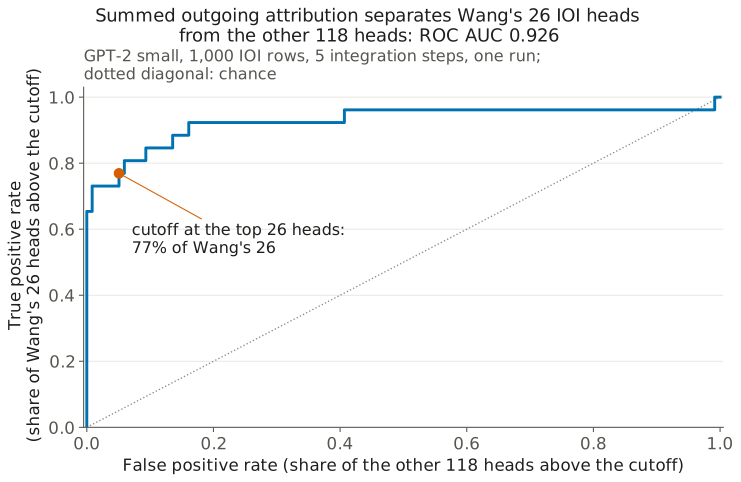
Wang et al.'s 26-head indirect-object-identification circuit is the membership oracle for an EAP-IG ranking on GPT-2 small; the fixed 1,000-row run passed with head ROC AUC 0.9263.
| Field | Value |
|---|---|
| Claim | Wang et al., Interpretability in the Wild: a Circuit for Indirect Object Identification in GPT-2 small, ICLR 2023, arXiv 2211.00593 |
| Script and run line | python examples/gallery/ioi_circuit.py --out outputs/ioi_circuit |
| Pinned inputs | GPT-2 small revision 607a30d783dfa663caf39e06633721c8d4cfcd7e; MIB IOI revision e5f3468f3af4c0883be35cd3bced8c711c95d286; 1,000 training rows; five steps; seed 0 |
| Verdict | Passed; x86_64 CPU; 3 November 2026, 8:25 AM PT; TorchLens 2.36.3; commit fd37ce87dcae9391c5dbfabafcc6dfd5ae5ab9f5 |
| Cost | 6,085.8 s script wall time; two CPU cores; 6,800,248 KiB process peak RSS |
Oracles
Rank each head by the sum of the absolute scores of its outgoing edges, including every head in the comparison. The head ROC AUC against Wang membership must be at least 0.80. The script verifies the pinned training file's SHA-256 before selecting the first 1,000 rows with equal token lengths for the indirect-object, subject and random names. Tokenization follows the MIB convention: BOS, right padding and the last real position. The metric is minus the IO-minus-subject logit difference.
Head recall at 26 and head-only edge recall at 182 are reported without gating. The
182-edge oracle expands the head-class connections in the published ACDC IOI oracle at
commit bc99ace817974b5584b7ee203d596a8e2bbcd399. Exact edge-patching rank agreement is
not measured within this entry's CPU budget. Head ROC AUC was 0.926336, passing the
0.80 bar. Head recall at 26 was 0.769231; edge recall at 182 was 0.395604. The pinned
training file SHA-256 was 2ee41861d725eee2b71da3846872d5e5ea29d9d8c9aa3a8954f8430584b2f243.
Controls
Rules are fixed before running. On the first 32 selected rows, independently replacing every name occurrence with a seeded ordinary random token removes the repeated-name IOI structure. Its head ROC AUC must lie in [0.40, 0.60]. Reversing clean and corrupt inputs, while retaining the metric, must give a Pearson correlation of edge scores at most -0.90 with the normal run on the same rows. A failed control fails the entry. Both controls passed: scrambled-name AUC was 0.403846, passing [0.40, 0.60]; reversed-role Pearson was -0.996254, passing the -0.90 bar. Both used 32 rows.
Artifact and replay
The script saves ioi_circuit.tlspec, a representative clean trace containing the complete
aggregate edge-score table in its annotations, and edge_scores.json. Reloading the trace
recomputes the top-k ranking from the saved scores and checks exact head-name agreement.
This is ranking replay, using a representative capture; the intermediate integration
captures are not archived. The portable directory totals 52,632,361 bytes, with the
gallery helper's sorted-path and content SHA-256
e7b5583962688481f0a99f39b3c14a9c98e6964607ba1a3c6465aa6eec7c2a2d.
Reload reproduced all 26 ranked head names exactly. This verifies saved-score replay,
not an independent rerun of the model or all interpolation captures.
The script reduces the saved scores to ioi_circuit_figure.json, and the shared
_figures.py renderer writes ioi_roc.png / .svg and ioi_circuit.png / .svg from
that file (--figure-only redraws them without rerunning the model). The graph shows the 20 strongest absolute head-to-head q/k/v edges,
with Wang's head classes colored and all other heads grey. Arrow width encodes absolute
attribution, without asserting that an edge is necessary. Edges for different q/k/v
channels can share endpoints and overlap; the saved table retains each channel identity. The ROC uses all 144 heads
against the 26-head membership set. These are single-run diagnostics, with no uncertainty
intervals; they do not replace the oracle or controls.
Basis-grid row
Core verbs: capture, read, save. The script counts its marked TorchLens region, containing the batch scorer and artifact round trip, and its plain region, containing the membership ROC and oracle-edge expansion. These regions perform different jobs; their lengths are not an implementation-efficiency comparison. The measured counts were 48 TorchLens lines and 19 plain lines at the stamped commit; the later closure-binding lint fix adds seven TorchLens signature lines without changing the computation. Reference implementation length is not measured. Architecture: GPT-2 small.
The stamp
{"commit": "fd37ce87dcae9391c5dbfabafcc6dfd5ae5ab9f5", "date_utc": "2026-11-03T16:25:03Z", "device": "cpu", "libraries": {"numpy": "2.2.6", "torchvision": "0.28.0+cpu", "transformers": "5.18.0"}, "machine": "x86_64", "platform": "Linux-5.15.0-139-generic-x86_64-with-glibc2.31", "python": "3.10.19", "torch": "2.13.0+cpu", "torch_threads": 2, "torchlens": "2.36.3", "wall_seconds": 6085.8}
Vary it
Use --k to change the reported head count, --steps to change integration resolution and
--rows to change the data prefix. The full oracle requires 1,000 rows and five steps;
--quick exercises two real-model rows at one step and cannot pass that full oracle.
The executed stand-in uses a seeded two-layer GPT-2 with no downloaded weights. It scores every component edge and checks that each score is available.
# recipe-test: tool=transformers expected=True
import torch
from transformers import GPT2Config, GPT2LMHeadModel

import torchlens.mechinterp as mi

torch.manual_seed(0)
config = GPT2Config(n_layer=2, n_head=2, n_embd=8, vocab_size=32,
                   n_positions=16, use_cache=False)
config._attn_implementation = "eager"
model = GPT2LMHeadModel(config).eval()
clean = torch.tensor([[3, 7, 1, 9]])
corrupt = torch.tensor([[5, 7, 2, 9]])
table = mi.edge_scores(model, clean, corrupted_input=corrupt,
                       metric=lambda logits: logits[:, -1, 1] - logits[:, -1, 2],
                       steps=1)
scores = {row.address[0]: row.score for row in table.rows()}
RESULT = len(scores) == 57 and all(value is not None for value in scores.values())